
Australia
AASB S2: Mandatory Climate Reporting in Australia
An overview of who must report under AASB S2, what must be disclosed and how Australian businesses can prepare.
Table of Contents
- Expert Arm
- 26 min read
What is AASB S2?
AASB S2 is the Australian reporting standard that requires affected entities to disclose material climate-related risks and opportunities that could influence their financial position, performance, cash flows, access to finance or cost of capital.
Its full title is AASB S2 Climate-related Disclosures. The standard explains what climate information must be reported, how that information should be organised and how it should connect with the entity’s financial reporting.
The Corporations Act 2001 determines which entities must prepare a sustainability report. AASB S2 supplies the detailed disclosure requirements for those entities. In practical terms, the legislation establishes the obligation and AASB S2 explains what must appear in the report.
AASB S2 is based on the international IFRS S2 standard, with changes made for the Australian reporting environment. It can be applied without adopting the voluntary AASB S1 standard because the general requirements needed for climate reporting are included in Appendix D of AASB S2.
PDF reference: AASB S2 Climate-related Disclosures, Preface and paragraphs 1–4, pp. 4–6; Appendix D, p. 30. Treasury Laws Amendment (Financial Market Infrastructure and Other Measures) Act 2024, Schedule 4, sections 292A and 296C, printed pp. 251–256.
Executive Summary
Australia’s mandatory climate reporting regime brings climate-related information into the annual corporate reporting process. An entity within scope must prepare a sustainability report alongside its annual financial report and explain how material climate-related risks and opportunities affect its governance, strategy, risk management and financial outlook.
The regime is being introduced in three stages:
- Group 1 commenced for financial years beginning on or after 1 January 2025.
- Group 2 commenced for financial years beginning on or after 1 July 2026.
- Group 3 is scheduled to commence for financial years beginning on or after 1 July 2027.
The reporting obligation applies only where the entity is required to prepare an annual financial report under Chapter 2M of the Corporations Act and meets one of the sustainability reporting thresholds.
The central requirements include:
- An annual sustainability report containing climate statements, supporting notes and a directors’ declaration.
- Disclosure of governance, strategy, risk management, metrics and targets.
- Reporting of Scope 1, Scope 2 and, subject to first-year relief, Scope 3 greenhouse gas emissions.
- Climate scenario analysis using at least a 1.5°C scenario and a scenario well exceeding 2°C.
- Disclosure of current and anticipated financial effects.
- Retention of supporting sustainability records for seven years.
- Independent assurance that increases in scope over the transition period.
The main conclusion is that climate reporting cannot be completed as a separate narrative exercise at year-end. It requires reliable operational data, documented calculations, clear management responsibility, board oversight and consistency with the financial statements.
For accountants, the change extends beyond preparing an additional report. Climate assumptions may affect forecasts, asset impairment, useful lives, provisions, expected credit losses and other accounting judgements. Businesses therefore need to build climate information into their existing financial reporting and control environment.
The Law
Which law introduced mandatory climate reporting?
Mandatory climate reporting was introduced through Schedule 4 of the Treasury Laws Amendment (Financial Market Infrastructure and Other Measures) Act 2024.
The Act received Royal Assent on 17 September 2024 and amended the Corporations Act 2001 to establish:
- Sustainability reporting obligations.
- Reporting thresholds and commencement dates.
- Requirements for climate statements and supporting notes.
- Directors’ declaration requirements.
- Sustainability recordkeeping obligations.
- Audit and review requirements.
- Powers for ASIC to administer the regime.
- Transitional liability arrangements.
“Mandatory climate-related financial disclosures” is the commonly used name for the regime. It is not the formal title of a separate Act.
PDF reference: Treasury Laws Amendment (Financial Market Infrastructure and Other Measures) Act 2024, Schedule 4, printed pp. 245–285.
What does the law require an entity to prepare?
An affected entity must prepare an annual sustainability report consisting of:
- The climate statements required for the financial year.
- Notes required by the sustainability standards or a legislative instrument.
- Any statements or notes concerning other environmental sustainability matters that may be prescribed.
- A directors’ declaration concerning the statements and notes.
Climate reporting is currently the first mandatory component of the statutory sustainability report. ASIC provides an overview of the current framework through its sustainability reporting information hub.
PDF reference: Amending Act, Schedule 4, section 296A, printed pp. 253–254.
How does AASB S2 become part of the legal requirement?
The Corporations Act requires climate statements and notes to comply with applicable sustainability standards. It authorises the AASB to make those standards for the purposes of the Act.
AASB S2 therefore operates as part of the statutory reporting framework for entities required to prepare a sustainability report.
The Act also identifies minimum climate matters that the standard must address, including:
- Material climate-related risks and opportunities.
- Governance arrangements.
- Strategy.
- Risk management.
- Metrics and targets.
- Scope 1, Scope 2 and Scope 3 greenhouse gas emissions.
- Climate scenario analysis.
PDF reference: Amending Act, Schedule 4, sections 296C, 296D and 336A, printed pp. 256–258 and 276–277.
Is the sustainability report separate from the financial report?
The sustainability report is a separate statutory report, but it accompanies the annual financial report and forms part of the entity’s annual reporting obligations.
The climate disclosures should use information and assumptions that are consistent with the financial statements to the extent possible. Where information in the sustainability report relates to figures or assumptions in the financial statements, the relationship should be clear.
PDF reference: AASB S2, Appendix D, paragraphs 21–24 and 60–64, pp. 31–33.
When must the report be lodged?
The sustainability report and the auditor’s report on it are generally lodged with ASIC:
- Within three months after financial year-end for disclosing entities, registered schemes and registrable superannuation entities.
- Within four months after financial year-end for other reporting entities.
For entities with a 30 June 2026 year-end, ASIC identifies the following deadlines:
- 30 September 2026 for disclosing entities.
- 31 October 2026 for other reporting entities.
The detailed requirements and electronic lodgement arrangements are available from ASIC’s official guidance on when and how to lodge a sustainability report.
Who Must Report?
What conditions bring an entity into the regime?
An entity must satisfy two levels of assessment:
- It must be required to prepare an annual financial report under Chapter 2M of the Corporations Act.
- It must meet the corporate size, emissions or asset value pathway in section 292A.
An entity without a Chapter 2M annual financial reporting obligation does not become a mandatory sustainability reporter solely because it has climate exposure.
ASIC confirms this structure in its guidance on who must prepare a sustainability report.
What are the corporate size thresholds?
Under the general corporate size pathway, an entity must satisfy at least two of the three tests for the relevant group.
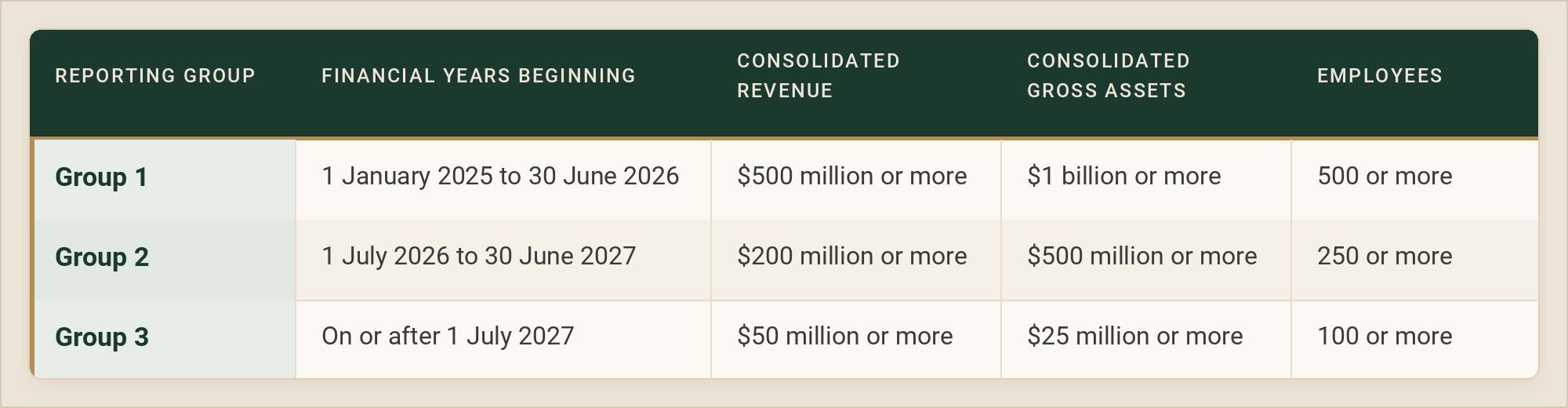
Revenue and gross assets are assessed on a consolidated basis where the entity controls other entities. Part-time employees are counted as an appropriate fraction of a full-time employee.Control, consolidated revenue and consolidated gross assets are determined using the applicable accounting standards.
PDF reference: Amending Act, Schedule 4, sections 292A and 1707B, printed pp. 251–253 and 279–281; ASIC Regulatory Guide 280: Sustainability Reporting, Table 2 and paragraphs RG 280.34–48, pp. 13–17.
How do the thresholds apply in practice?
Assume a distribution company has:
- Consolidated revenue of $240 million.
- Consolidated gross assets of $180 million.
- 280 full-time equivalent employees.
The company satisfies the Group 2 revenue and employee tests. It does not need to satisfy the asset test because meeting two of the three criteria is sufficient. If the company has a 30 June year-end and meets the Chapter 2M requirement, its first mandatory reporting period begins on 1 July 2026 and ends on 30 June 2027. The assessment should be repeated for each financial year. Growth, restructuring, acquisitions and disposals can change the entity’s reporting position.
Which NGER entities are affected?
Separate provisions apply to corporations registered, or required to register, under the National Greenhouse and Energy Reporting Act 2007.
An NGER corporation may enter Group 1 where it also meets the specified NGER group threshold. Other NGER corporations with reporting obligations generally enter through Group 2.
NGER information may provide a useful starting point for emissions reporting, but the reporting boundaries and disclosure requirements under AASB S2 still need to be assessed separately.
PDF reference: Amending Act, Schedule 4, sections 292A(5) and 1707B(4), printed pp. 252–253 and 280.
Which asset owners are affected?
A registered scheme, registrable superannuation entity or retail corporate collective investment vehicle may be required to report where it and its controlled entities have assets with a total value of $5 billion or more at financial year-end.
These entities enter from Group 2 rather than Group 1.
PDF reference: Amending Act, Schedule 4, sections 292A(6) and 1707B, printed pp. 252–253 and 279–281; RG 280, paragraphs RG 280.35–40, pp. 14–15.
Can an Australian subsidiary rely on its overseas parent’s report?
An Australian entity must assess its own obligations under Chapter 2M and section 292A.
An overseas parent’s sustainability report does not automatically replace the Australian entity’s statutory report. Where the Australian entity is itself required to report, its report must address the Australian legal requirements, receive the required directors’ approval and be lodged with ASIC.
PDF reference: RG 280, paragraphs RG 280.45–48, p. 17.
Does Group 3 have a simplified reporting option?
An eligible Group 3 entity may prepare a statement that it has no material climate-related risks or opportunities if that conclusion is supported by a proper assessment.
The statement must explain the reasons for the conclusion. The entity must still prepare the required sustainability report, directors’ declaration and supporting records, and the statement remains subject to the applicable assurance requirements.
Having low direct emissions does not necessarily mean the business has no material climate exposure. The assessment should also consider suppliers, customers, financing, insurance, physical locations and regulatory or market changes.
PDF reference: Amending Act, Schedule 4, section 296B, printed pp. 254–256; RG 280, paragraphs RG 280.73–77, pp. 26–27.
Are smaller businesses affected?
Businesses below the reporting thresholds are generally outside the direct statutory obligation unless another reporting pathway applies.
They may still receive information requests from customers, lenders or larger entities calculating their Scope 3 emissions. ASIC explains the distinction between direct obligations and supply-chain effects on its sustainability reporting page for small businesses.
What Must Be Disclosed?
What are the four main areas of AASB S2?
AASB S2 organises the required disclosures around four connected areas.
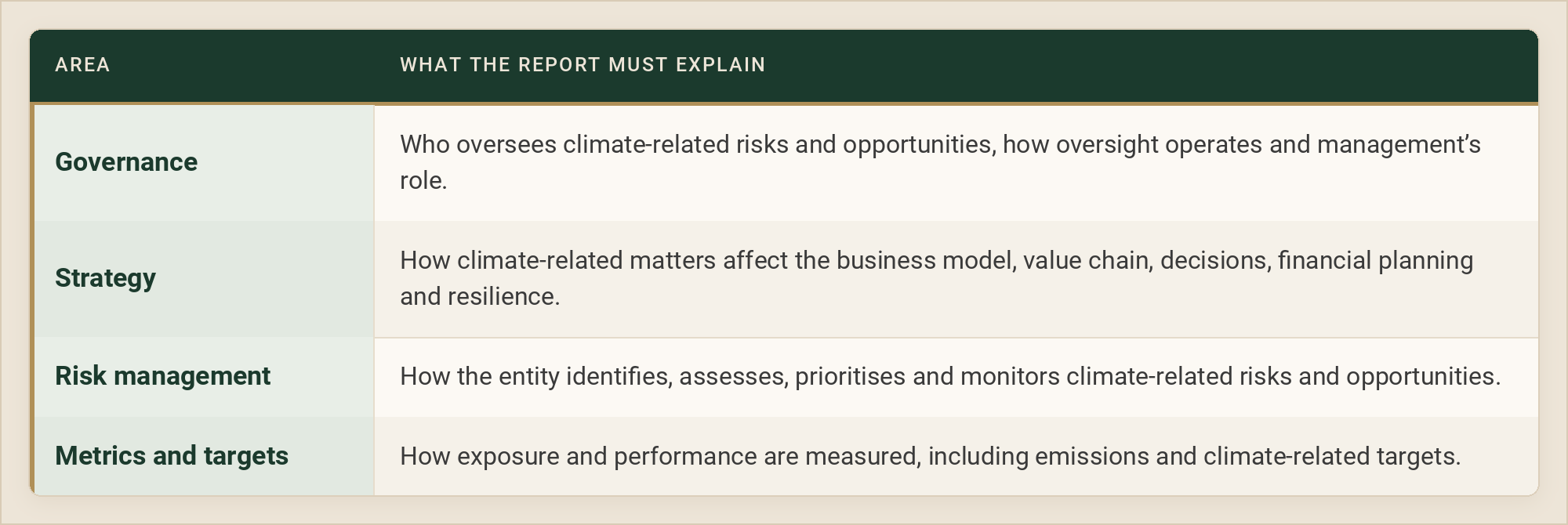
The four areas should describe a consistent process. A risk identified in the strategy section should also be visible in the entity’s risk assessment, management reporting and governance arrangements.
PDF reference: AASB S2, paragraphs 5–36, pp. 6–14.
What information is material?
Information is material when omitting, misstating or obscuring it could reasonably be expected to influence decisions made by users of the entity’s general purpose financial reports.Materiality depends on the nature and magnitude of the matter in the entity’s circumstances.
For example, a warehouse may represent only a small part of total group assets but remain material if it is the entity’s only distribution facility. Flood exposure affecting that warehouse could influence revenue, inventory, insurance and the continuity of operations.
The assessment focuses on information relevant to investors, lenders and other creditors. It is not determined only by whether an issue is environmentally significant.
PDF reference: AASB S2, Appendix D, paragraphs 17–19, p. 31.
What are physical climate risks?
Physical climate risks arise from the actual or expected effects of climate change. They may be:
- Acute, such as floods, bushfires, storms or extreme heat events.
- Chronic, such as rising temperatures, changing rainfall, water scarcity or sea-level rise.
The financial consequences may include damaged assets, higher maintenance costs, business interruption, supply shortages, reduced productivity and changes in insurance availability or premiums.
PDF reference: AASB S2, paragraphs 10–14, pp. 7–8; Appendix A, pp. 15–17.
What are transition risks?
Transition risks arise from the economic and commercial changes associated with moving towards a lower-emissions economy.
They may result from:
- New legislation or regulatory obligations.
- Changes in energy and input costs.
- New technologies.
- Changes in customer demand.
- Financing or insurance conditions.
- Reputational considerations.
- The replacement or early retirement of equipment.
The report should also consider climate-related opportunities, such as lower energy costs, more resilient infrastructure, improved access to finance or demand for new products and services.
PDF reference: AASB S2, paragraphs 10–14, pp. 7–8; Appendix A, pp. 15–17.
What does climate scenario analysis require?
Climate scenario analysis examines how the business may perform under different plausible climate futures.
The Corporations Act requires the entity to use at least:
- One scenario in which global average temperature increases by 1.5°C above pre-industrial levels.
- One scenario in which the increase well exceeds 2°C above pre-industrial levels.
The analysis should examine the resilience of the organisation’s strategy and business model. It may consider changes in demand, supply, regulation, operating costs, asset use, financing and physical disruption.
A scenario is not a forecast that management claims will occur. It provides a structured way of examining uncertainty and testing whether the business can respond under different conditions.
The method should be proportionate to the entity’s circumstances, exposure and available skills and resources. AASB S2 permits qualitative and quantitative approaches depending on the nature of the assessment.
PDF reference: Amending Act, Schedule 4, section 296D(2A)–(2B), printed pp. 257–258; AASB S2, paragraph 22, pp. 10–11, and paragraphs B1–B18, pp. 18–20.
What are Scope 1, Scope 2 and Scope 3 emissions?
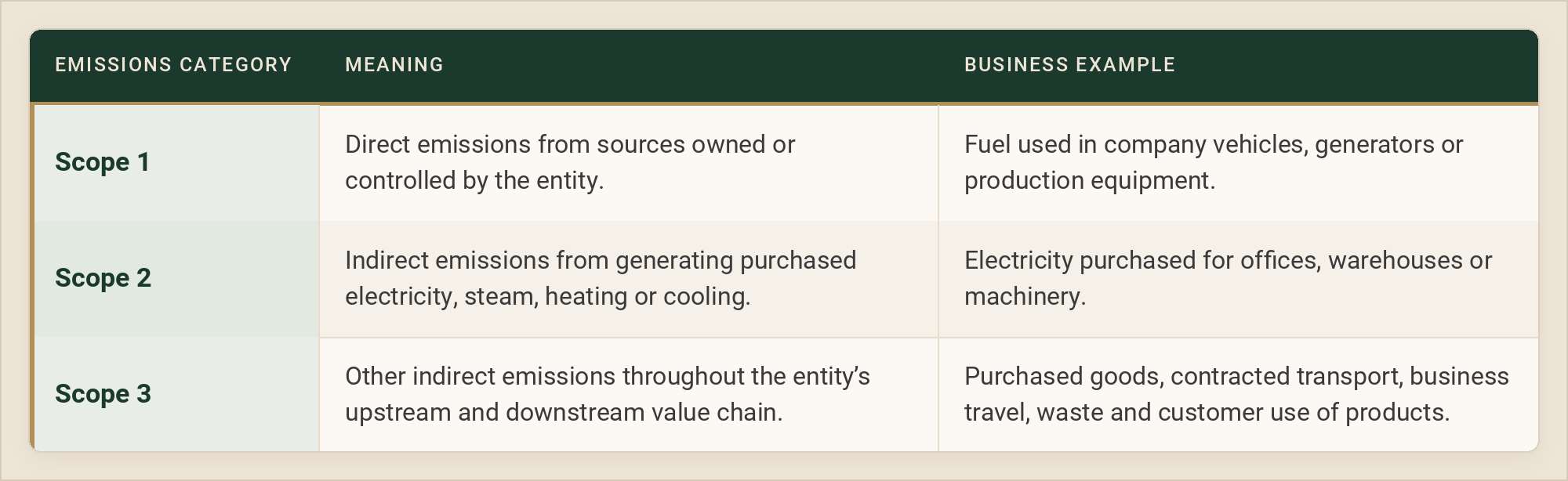
The entity must establish an emissions reporting boundary before measuring its emissions. That assessment determines which operations and activities are included and how emissions are classified.
AASB S2 requires absolute gross Scope 1, Scope 2 and Scope 3 emissions to be expressed in tonnes of carbon dioxide equivalent, subject to the standard’s transitional provisions.
Scope 2 emissions are reported using a location-based approach, together with information about contractual arrangements where relevant.
PDF reference: AASB S2, paragraph 29(a), p. 12, and paragraphs B19–B31, pp. 20–22.
How should Scope 3 emissions be calculated?
The entity must consider the relevant activities across its value chain and the 15 Scope 3 categories. It must identify which categories are included in its measurement. Scope 3 information will often involve estimates. Supplier-specific information may be used where available, while industry averages and other secondary data may be appropriate where direct information cannot reasonably be obtained.
The reporting file should document:
- The activities and categories included.
- The data sources used.
- The calculation method.
- Material assumptions.
- The emission factors applied.
- Estimation uncertainty.
- Changes from the previous reporting period.
Direct measurement is generally prioritised when other factors are equal, but AASB S2 recognises that Scope 3 reporting will often rely partly on estimates.
PDF reference: AASB S2, paragraphs B32–B57, pp. 22–25.
What financial effects must be disclosed?
The entity must explain both:
- Current financial effects: how climate-related risks and opportunities affected its financial position, financial performance and cash flows during the reporting period.
- Anticipated financial effects: how they are expected to affect the entity over the short, medium and long term.
AASB S2 requires quantitative information where applicable. Relief may be available where an effect cannot be identified separately, measurement uncertainty is so high that quantitative information would not be useful, or the entity lacks the necessary skills, capabilities or resources for particular anticipated effects. Where relief is used, the entity must explain why quantitative information has not been provided and supply the required qualitative information.
PDF reference: AASB S2, paragraphs 15–21, p. 9.
How can climate information affect the financial statements?
Climate-related matters can affect estimates and judgements already made under Australian Accounting Standards.
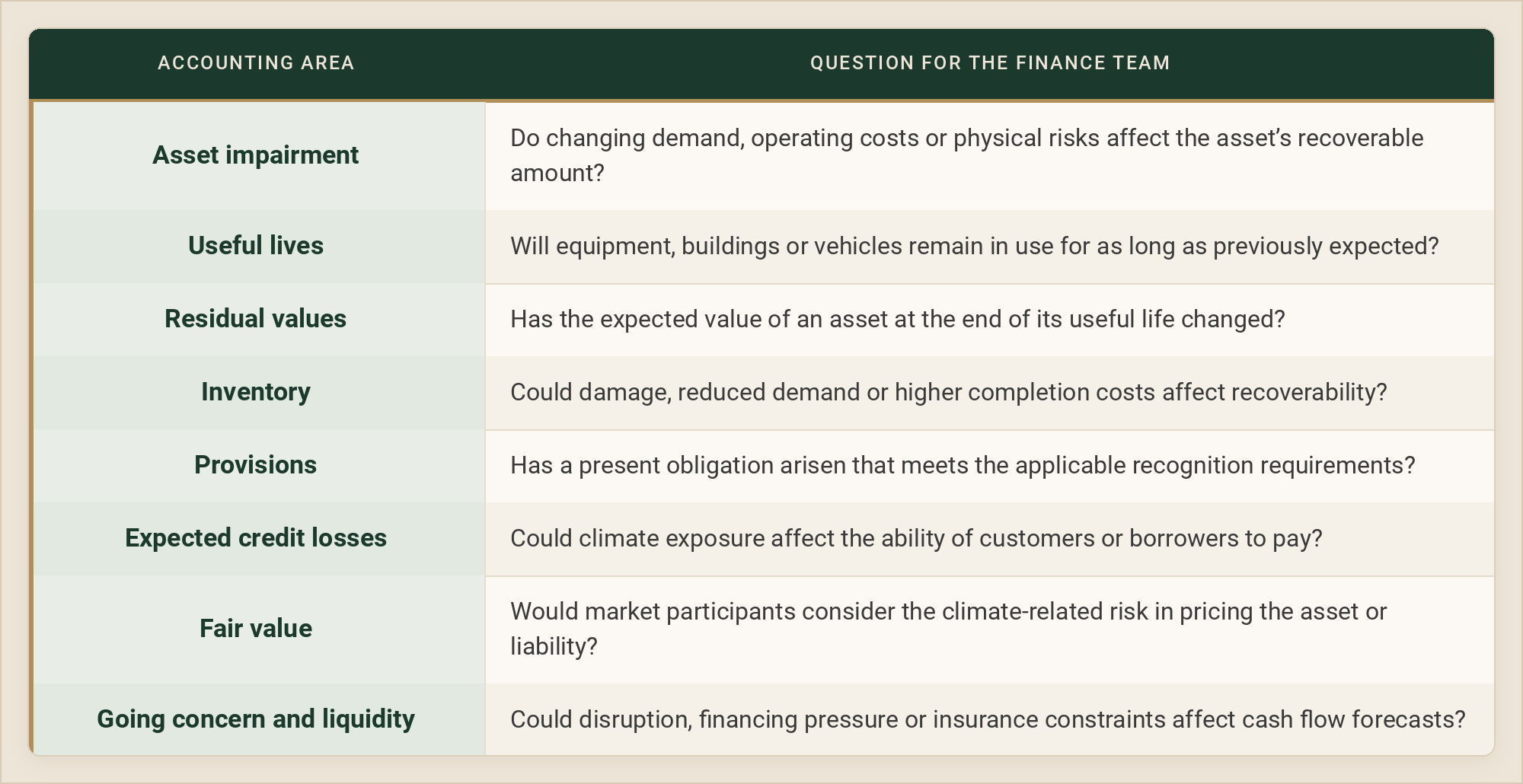
A scenario result does not automatically create an accounting entry. Accountants must assess the result against the recognition and measurement requirements of the relevant accounting standard. The assumptions used across the financial statements and sustainability report should also be consistent. If the climate report describes the early retirement of equipment, the finance team should consider whether depreciation, impairment and forecast assumptions reflect that plan.
PDF reference: AASB S2, paragraphs 15–21, p. 9; Appendix D, paragraphs 21–24, pp. 31–32.
How would the requirements apply to a business?
Consider the Group 2 distribution company described earlier.
The company identifies:
- A warehouse exposed to increased flood risk.
- A delivery fleet that may require replacement as transport requirements change.
- Higher insurance premiums.
- Customer demand for lower-emissions delivery services.
- Emissions from company vehicles, purchased electricity and contracted freight.
Its reporting process could include:
- Assigning board and management responsibility for climate-related matters.
- Assessing flooding as a physical risk and fleet replacement as a transition risk.
- Measuring fuel-related Scope 1 emissions.
- Measuring purchased electricity as Scope 2 emissions.
- Assessing contracted freight and purchased goods for Scope 3 reporting.
- Testing warehouse resilience under the required climate scenarios.
- Estimating possible revenue interruption, repair expenditure and insurance recoveries.
- Considering whether the same assumptions affect asset impairment, useful lives or provisions.
- Retaining the records supporting each calculation and judgement.
Suppose one warehouse supports weekly sales of $800,000, earns a 25% contribution margin and is unavailable for four weeks after a flood. If the sales cannot be recovered, the estimated lost contribution would be:
$800,000 × 25% × 4 weeks = $800,000
If the scenario also assumes repair costs of $400,000, the modelled effect would be $1.2 million before insurance recoveries or management responses.
Management would then examine the assumptions behind the result, including alternative premises, inventory transfers, insurance coverage and whether customers would delay or cancel their orders. The analysis supports the climate disclosure and may inform related financial reporting assessments.
Does AASB S2 require every entity to set a net-zero target?
AASB S2 does not require every entity to establish a net-zero target or create a transition plan.
Where the entity has a climate target, or is required by law to meet one, it must disclose relevant information about that target. This may include:
- The metric used.
- The target period.
- The baseline period.
- Interim milestones.
- Whether the target is absolute or intensity-based.
- Performance against the target.
- Any intended use of carbon credits.
Where the entity has a transition plan, the report should explain the relevant aspects of that plan and the progress made.
PDF reference: AASB S2, paragraph 14(a), pp. 7–8, and paragraphs 33–36, pp. 13–14.
What relief applies in the first year?
In the first annual period in which an entity applies AASB S2:
- Comparative information is not required.
- Scope 3 emissions, including applicable financed emissions information, may be omitted.
- An entity that used another greenhouse gas measurement method in the immediately preceding period may continue using that method for its first year.
Related comparative relief applies in the following period where one of these concessions was used.
These concessions do not remove the remaining disclosure requirements or delay the need to establish the systems required for later reporting periods.
PDF reference: AASB S2, Appendix C, paragraphs C2–C5, p. 29.
Which version of AASB S2 applies?
The September 2024 edition applies to annual reporting periods beginning on or after 1 January 2025.
Amendments issued in December 2025 apply to annual periods beginning on or after 1 January 2027, with earlier application permitted. Those amendments address selected greenhouse gas disclosures, including aspects of financed emissions, industry classification and jurisdictional measurement requirements.
Accountants should confirm the applicable version when preparing the reporting timetable and disclosure templates.
PDF reference: AASB S2, Appendix C, paragraph AusC1.1, p. 29; AASB S2025-1 Amendments to Greenhouse Gas Emissions Disclosures, pp. 5–6.
Governance and Assurance
What must the governance disclosures explain?
The report must identify the board, committee or individual responsible for overseeing climate-related risks and opportunities.
It should explain:
- How responsibilities are reflected in governance arrangements.
- How the responsible body develops or obtains appropriate skills.
- How and when it receives information.
- How climate matters influence strategy, significant transactions and risk management.
- How progress against targets is monitored.
- Whether climate-related performance is considered in remuneration.
- Management’s role and how it reports to the governing body.
The disclosure should reflect how oversight actually operates during the reporting period.
PDF reference: AASB S2, paragraphs 5–Aus7.1, pp. 6–7.
What must directors declare?
The sustainability report must include a directors’ declaration approved by a directors’ resolution, dated and signed in accordance with the Act.
For financial years commencing from 1 January 2025 to 31 December 2027, the declaration concerns whether, in the directors’ opinion, the entity has taken reasonable steps to ensure that the substantive provisions of the sustainability report comply with the Act.
This is a fixed statutory transition period. It is not a separate three-year period beginning when each entity first enters the regime.
For financial years beginning from 1 January 2028, the ordinary declaration requirement applies concerning whether the substantive provisions comply with the Act.
PDF reference: Amending Act, Schedule 4, sections 296A(6)–(7) and 1707C, printed pp. 254 and 281.
What records must be retained?
An entity must retain sustainability records that:
- Correctly explain and support the contents of the sustainability report.
- Enable the report to be prepared.
- Enable the report to be audited or reviewed.
The records must be kept for seven years after the report is completed.
A complete reporting file may include source invoices, meter data, calculation workbooks, supplier information, emission factors, risk assessments, scenario models, financial forecasts, approval records and explanations of significant judgements.
Where records are maintained outside Australia, the Corporations Act contains requirements concerning access to sufficient written information in Australia and notification to ASIC.
PDF reference: Amending Act, Schedule 4, sections 286A and 289A, printed pp. 248–250; RG 280, paragraphs RG 280.49–53, pp. 18–19.
How do the transitional liability protections work?
Temporary protections apply to specified statements concerning:
- Scope 3 emissions, including financed emissions.
- Scenario analysis.
- Transition plans.
The protections apply to qualifying statements made in statutory sustainability reports, and related auditor reports, for financial years commencing during the three-year period beginning on 1 January 2025.
A separate protection applies to certain forward-looking climate statements for financial years commencing during the first 12 months of the regime.
Criminal proceedings and actions brought by ASIC are excluded. The protections are specific and should not be treated as general immunity for the sustainability report or for statements repeated in marketing material.
ASIC explains these provisions through its official page on modified liability settings.
PDF reference: Amending Act, Schedule 4, section 1707D, printed pp. 281–283; RG 280, paragraphs RG 280.61–69, pp. 21–24.
What assurance is required?
The sustainability report is subject to independent assurance. The assurance scope increases over time.
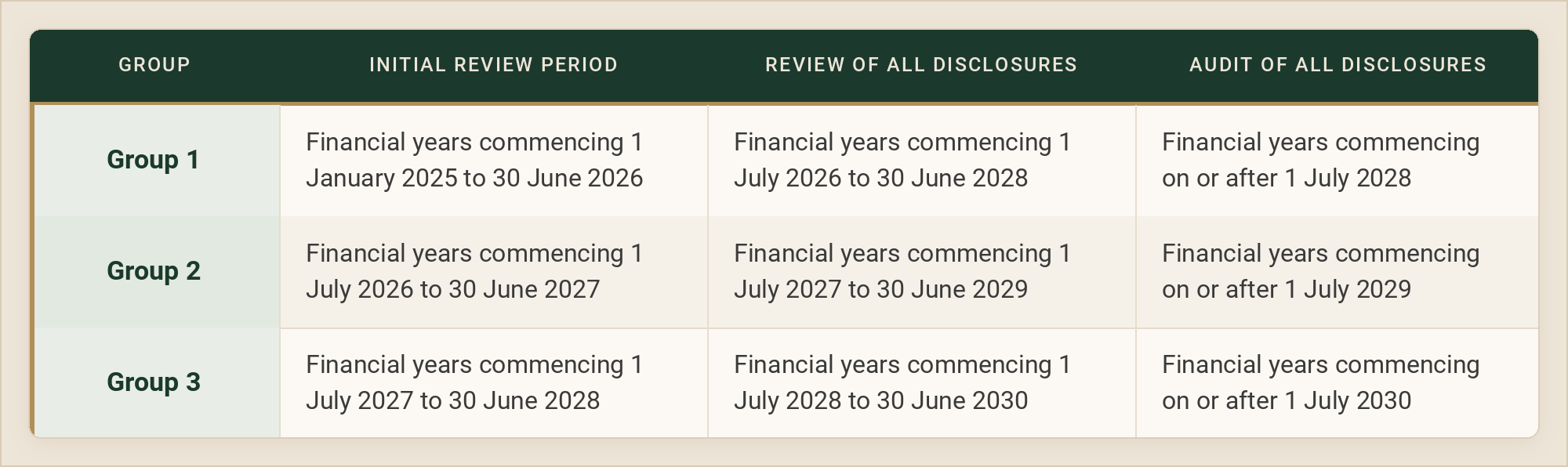
During the initial review period, limited assurance applies to specified information concerning:
- Governance.
- Identified climate-related risks and opportunities.
- Scope 1 and Scope 2 emissions.
- A statement that the entity has no material climate risks or opportunities, where applicable.
The second and third stages require limited assurance over all disclosures. The fourth stage requires reasonable assurance over all disclosures.
A review is a limited assurance engagement. An audit is a reasonable assurance engagement. Reasonable assurance involves more extensive procedures and provides a higher level of assurance, although it does not provide an absolute guarantee.
PDF reference: ASSA 5010 Timeline for Audits and Reviews of Information in Sustainability Reports, paragraphs 9–11 and Appendix, pp. 8–11.
Regulatory Oversight
What is ASIC’s role?
The Australian Securities and Investments Commission administers and enforces the sustainability reporting requirements under the Corporations Act.
ASIC describes its role as follows:
“ASIC will play a fundamental role in administering, and where appropriate, enforcing, the sustainability reporting requirements.”
ASIC can review lodged sustainability reports, request supporting information and use its statutory powers where reporting does not meet the required standard.
From 2026, ASIC’s directions power allows it to require an entity to:
- Confirm that a statement is correct or complete.
- Explain a statement.
- provide supporting information or documents.
- Correct, complete or amend a statement.
- Publish or distribute the corrected statement as directed.
ASIC’s responsibilities and planned review activities are explained on its page covering administration of the sustainability reporting requirements.
ASIC’s detailed interpretation and administrative guidance is contained in Regulatory Guide 280: Sustainability Reporting.
What has ASIC observed from early reports?
In May 2026, ASIC published early observations from the first sustainability reports prepared under the regime.
Its observations emphasised:
- Clearly locating judgements, assumptions and measurement uncertainty near the information they affect.
- Separating material information required by AASB S2 from additional voluntary information.
- Using precise cross-references to documents available on the same terms and at the same time as the sustainability report.
- Avoiding disclaimers that conflict with statutory responsibilities.
- Considering climate targets imposed by law as well as targets set voluntarily.
These observations provide useful direction for entities approaching their first reporting period. The complete findings are available in ASIC’s official release on early observations from sustainability reporting.
What is the AASB’s role?
The Australian Accounting Standards Board develops and maintains Australian accounting and sustainability reporting standards.
The AASB states:
“The AASB issues principles-based Australian accounting, sustainability and external reporting Standards and guidance…”
The AASB issued AASB S2 and is responsible for amendments to the standard. It does not perform the regulatory enforcement role carried out by ASIC.
The operative standards and their different versions are available through the AASB Sustainability Reporting Standards register.
What is the AUASB’s role?
The Auditing and Assurance Standards Board develops the standards used by independent auditors and assurance practitioners.
Its statutory functions include:
“making auditing standards under section 336 of the Corporations Act 2001”
For climate reporting:
- ASSA 5000 governs how sustainability assurance engagements are conducted.
- ASSA 5010 establishes the phased timetable for the information that must be reviewed or audited.
The entity’s independent auditor performs the assurance engagement. The AUASB sets the applicable professional requirements.
The AUASB’s role is explained through its official Standards and Guidance page.
What is the Clean Energy Regulator’s role?
The Clean Energy Regulator administers the National Greenhouse and Energy Reporting Scheme.
The regulator describes NGER as:
“a single national framework for reporting company information about” greenhouse gas emissions, energy production and energy consumption.
NGER status may affect when an entity enters mandatory climate reporting. Existing NGER information may also support emissions calculations, subject to the reporting boundaries and measurement requirements of AASB S2.
The legislative framework and current reporting requirements are available from the Clean Energy Regulator’s NGER Scheme page.
Is the regime still developing?
Treasury is responsible for government policy concerning the reporting framework.
On 23 August 2026, Treasury opened a consultation concerning possible changes to assurance settings, clarification of key reporting concepts and limits around information requests made across supply chains.
These matters were proposals under consultation at the date of this article. They do not replace the current reporting and assurance requirements described above. The consultation can be reviewed through the Australian Treasury consultation page.
Preparing for Compliance
What steps should a reporting entity take?
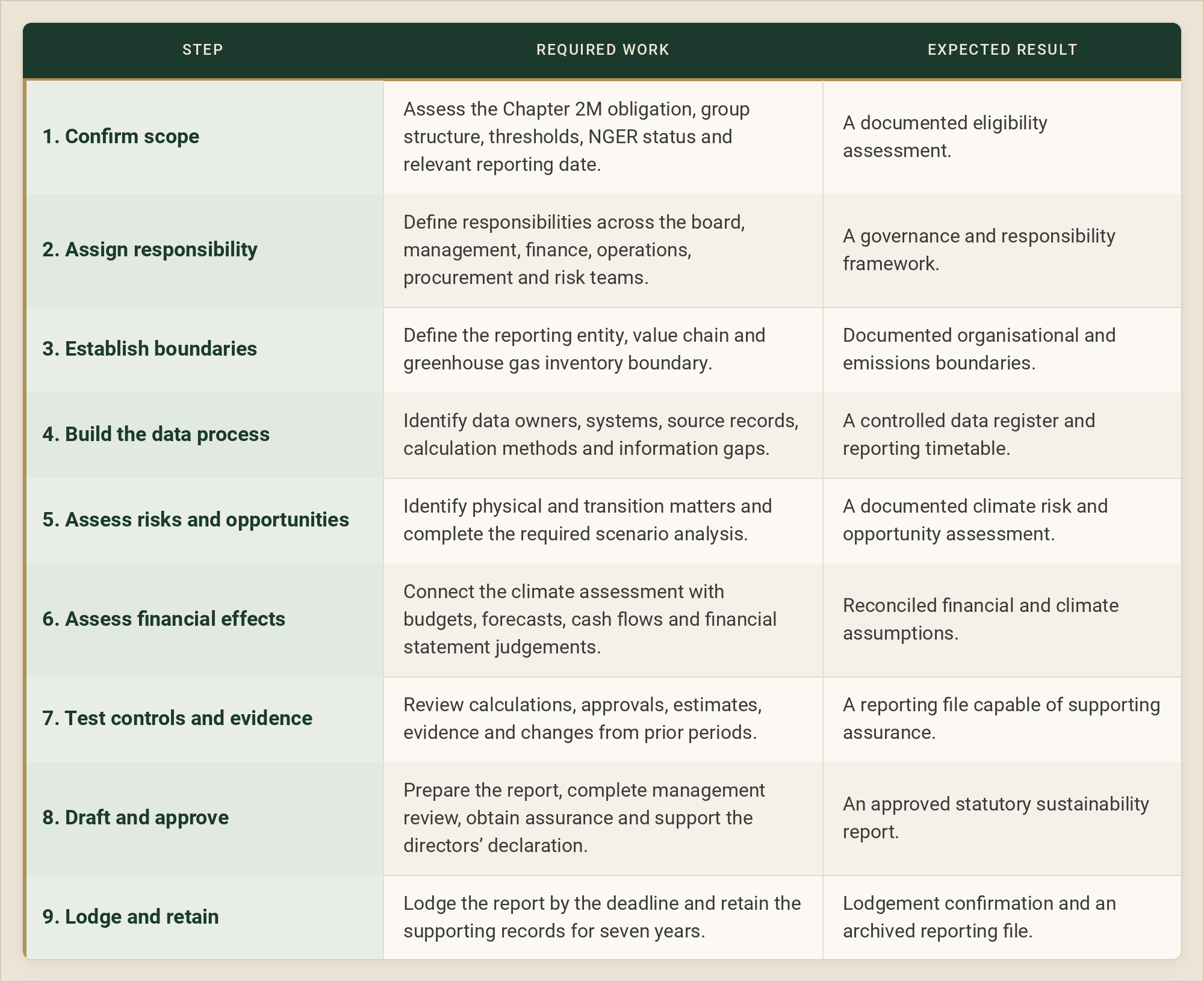
What should accountants change in their reporting processes?
Climate reporting often requires information that traditional accounting systems do not capture in a suitable form.
An electricity invoice supports an expense entry, but emissions reporting may also require electricity consumption, the location of the facility and the relevant emission factor. A freight invoice may need to be connected with shipment weight, distance or supplier emissions information.
Accountants should consider:
- Adding climate-related data requirements to monthly close procedures.
- Recording data owners and submission deadlines.
- Maintaining a register of calculation methods and emission factors.
- Documenting significant estimates and assumptions.
- Reconciling operational information to accounting records where possible.
- Investigating unusual movements and missing information.
- Checking consistency between climate scenarios, budgets and financial statement assumptions.
- Preserving evidence of management review and approval.
Collecting this information throughout the year reduces pressure at year-end and allows missing records to be addressed while they are still available.
How can internal audit support the process?
Internal audit can assess whether the reporting framework is properly designed and whether its controls are operating as intended.
An internal audit review may examine:
- Whether responsibilities are clearly assigned.
- Whether reporting boundaries are consistently applied.
- Whether source information is complete and reliable.
- Whether calculations are independently reviewed.
- Whether material judgements are documented.
- Whether exceptions are reported and resolved.
- Whether the board receives sufficient information.
- Whether the reporting file supports external assurance.
Internal audit readiness work remains separate from the independent statutory assurance engagement.
When should the external auditor become involved?
Engagement with the external auditor should begin before the sustainability report is complete.
Early discussions can help management understand:
- The assurance scope for the relevant year.
- The evidence the auditor will expect.
- Whether methodologies have been documented adequately.
- Which estimates may present assurance challenges.
- Whether specialists will be required.
- How assurance work will fit into the annual reporting timetable.
Leaving these discussions until the report has been drafted can expose missing evidence and control weaknesses when there is little time to resolve them.
Glossary
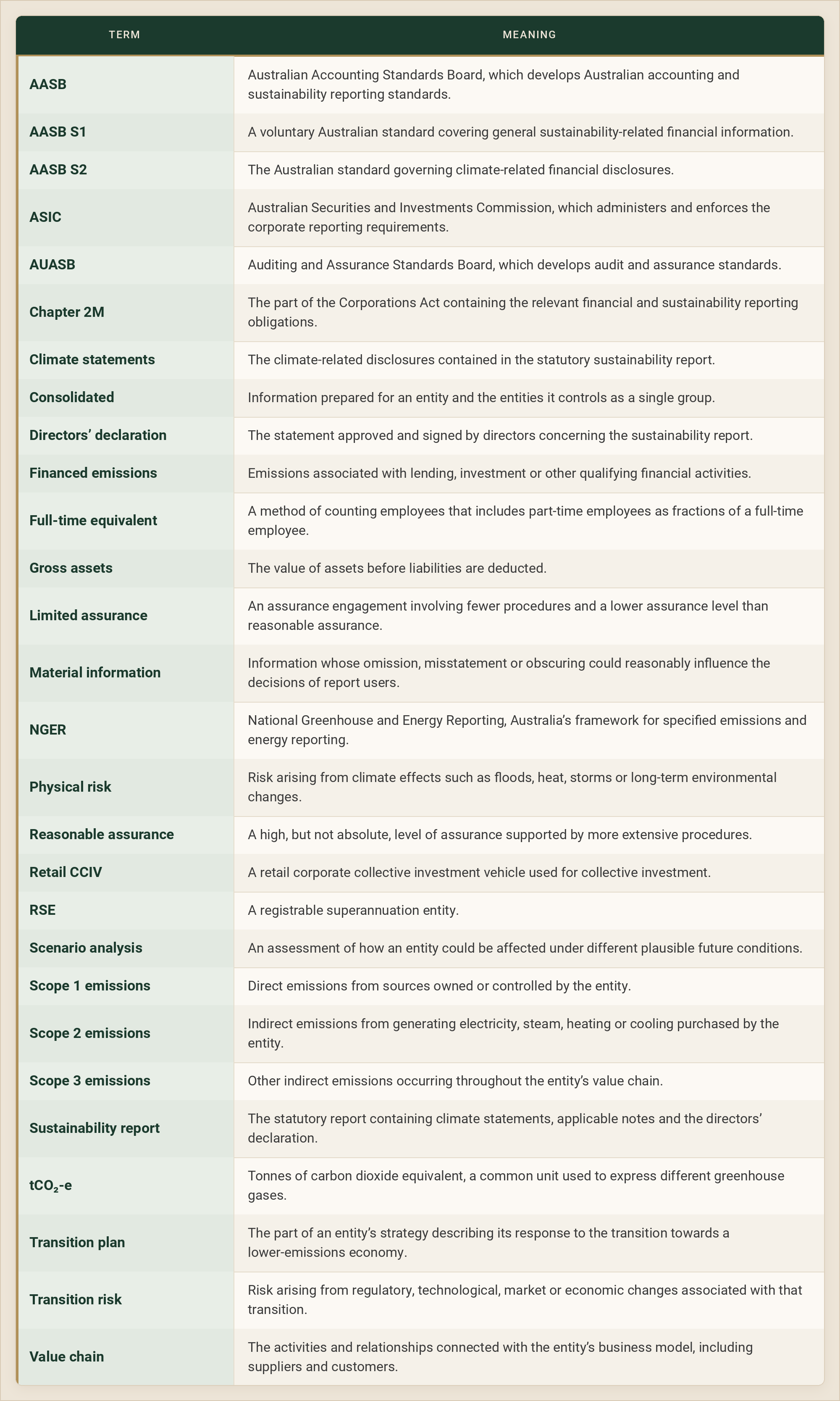
Conclusion
Mandatory climate reporting places climate-related information within Australia’s formal corporate reporting framework. It requires affected entities to explain how climate risks and opportunities influence their governance, strategy, operations and financial outlook.
A strong report begins with the systems behind it. Management needs reliable records, documented assumptions, clear responsibility and a consistent connection between operational information, climate analysis and the financial statements. These foundations also give directors a stronger basis for approving the report and support the independent assurance process. Expert Arm’s Accounts Outsourcing Services support the accounting records, reconciliations, reporting processes and financial data needed to build that foundation.
Our Internal Audit Services help businesses examine governance, reporting responsibilities, data controls and supporting evidence before those processes are tested through statutory external assurance. Together, these services help businesses develop a reporting environment in which climate-related information can be prepared, reviewed and supported with the same discipline expected of financial information.
Author
This insight was prepared and reviewed by Hassan Ahmed, CPA.
Official Sources
Federal Register of Legislation
- Corporations Act 2001 — current legislation
- Treasury Laws Amendment Act 2024 — official legislation record
Australian Securities and Investments Commission
- Sustainability reporting hub
- Who must prepare a sustainability report?
- What should a sustainability report contain?
- When and how to lodge a sustainability report
- Modified liability settings
- ASIC’s administration of the requirements
- Review and audit FAQs
- Early observations on sustainability reporting
- Sustainability reporting for small businesses
Australian Accounting Standards Board
Auditing and Assurance Standards Board
Clean Energy Regulator
Australian Treasury
- Climate-related financial reporting and guidance
- 2026 consultation on the efficiency of climate-related financial disclosures
Standard References
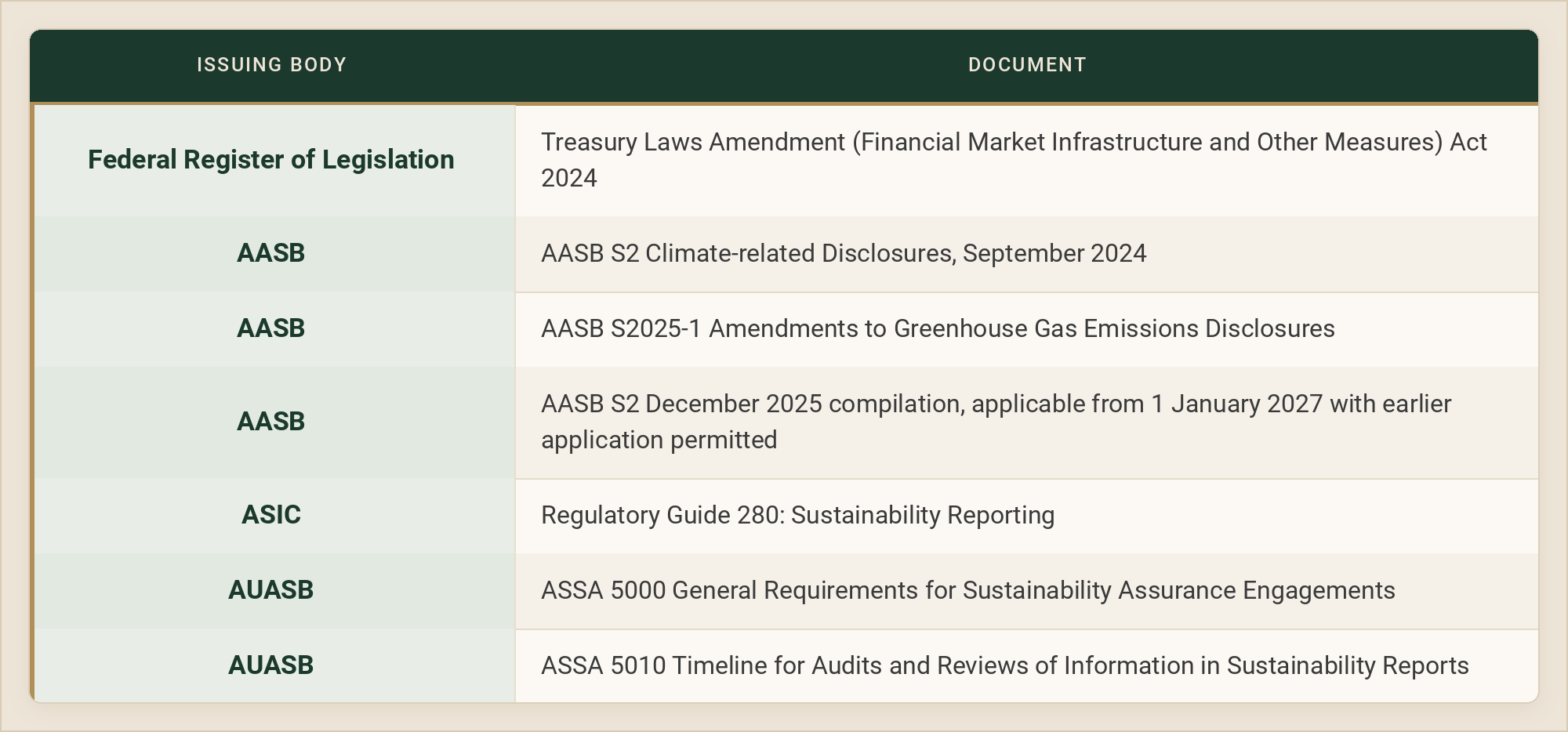
References
Supporting PDF sources
- AASB S2 Climate-related Disclosures — Reporting Standard Effective from 1 January 2025.pdfPDF document
- AASB S2 Greenhouse Gas Emissions Amendments — Applicable from 1 January 2027.pdfPDF document
- AASB S2 Updated Standard — Applicable from 1 January 2027.pdfPDF document
- ASIC Regulatory Guide 280 — Guide to Australia’s Sustainability Reporting Requirements.pdfPDF document
- ASSA 5000 — General Requirements for Sustainability Assurance.pdfPDF document
- ASSA 5010 — Audit and Review Timeline for Sustainability Reports.pdfPDF document
- Australian Mandatory Climate Reporting Legislation — Schedule 4 of the Treasury Laws Amendment Act 2024.pdfPDF document