Business
Payroll Control Practices
Learn seven practical payroll control practices that help reduce errors and support stronger business governance.
Table of Contents
- Internal Payroll Control Practices to Boost Financial Governance
- Separate Payroll Changes and Approval
- Reconcile Payroll Before Payment
- Separate Payroll Preparation and Payment
- Restructure Payroll Liabilities
- Review Year-End Payroll Reports
- Connect Payroll With Compliance
- Examine Payroll Controls as Business Grows
- Final Thoughts
- Frequently Asked Questions
- Author
- References
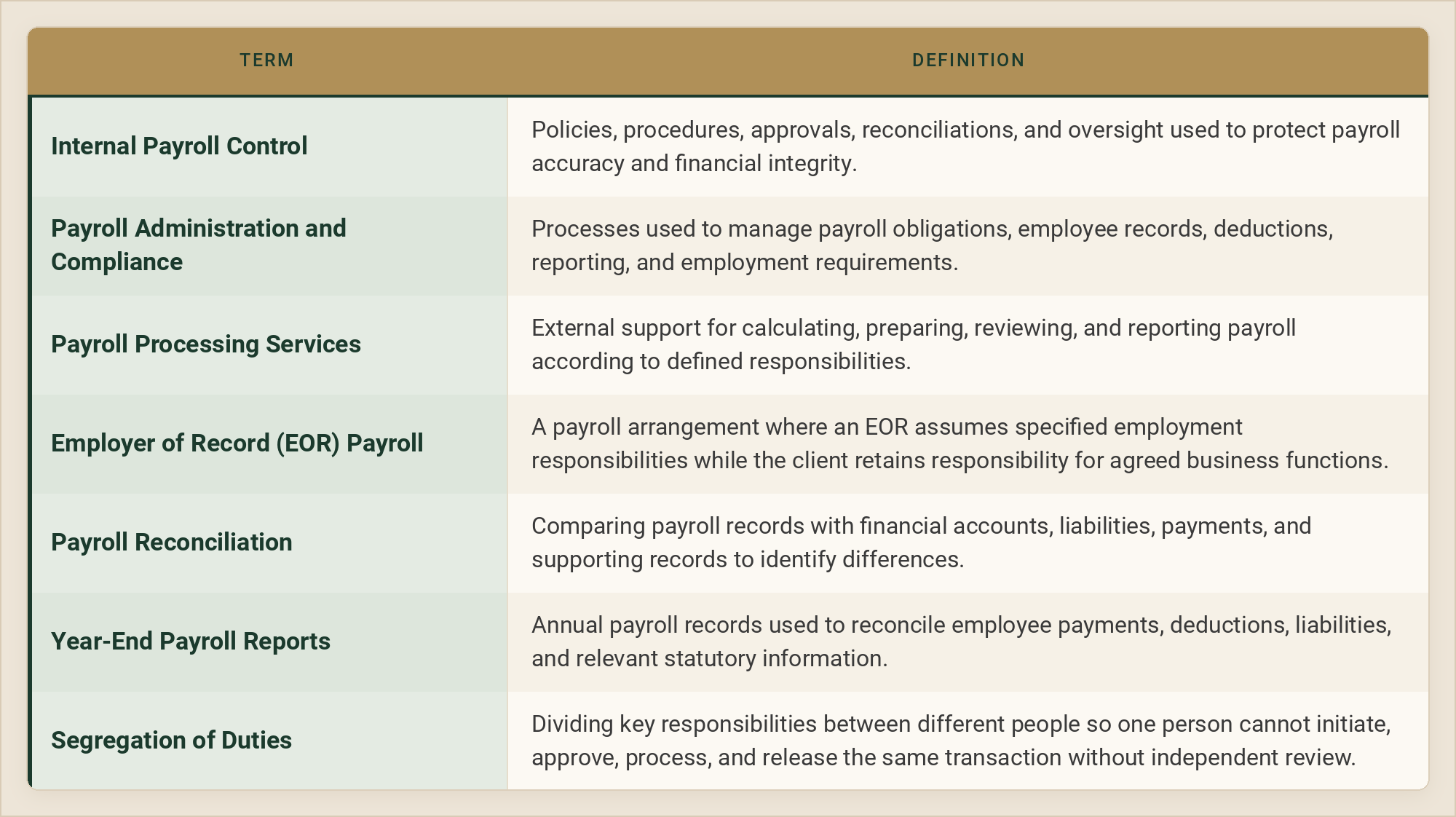
- Glossary
- Expert Arm
- 9 min read
Internal Payroll Control Practices to Boost Financial Governance
Payroll can look like a routine administrative process.
It is not!
Every pay cycle involves employee records, salary changes, calculations, approvals, deductions, and payments. When these activities are not properly controlled, a simple payroll error can become a financial, compliance, or reporting problem.
The risk is especially relevant as a business grows. More employees mean more changes to manage, more people involved, and more opportunities for something to go wrong.
Here are seven practical ways to strengthen internal payroll control and improve financial governance.
Separate Payroll Changes and Approval
Payroll data changes frequently!
New employees join. Salaries change. Allowances are added. Bank details are updated. Employees leave. The problem starts when the same person can make an important change and approve it without an independent check.
Consider a salary increase. A manager approves the increase. An employee updates the payroll system. The same person then processes the payroll.
What happens if the amount is entered incorrectly?
A simple review could catch the mistake before the payment is made.
The U.S. Department of Labor requires covered employers to maintain accurate records covering employee information, hours worked, wages, deductions, and payment details. The IRS also requires employers to retain employment-tax records, including wage payments, withholding certificates, tax deposits, and filed returns.
A practical control structure could look like this:
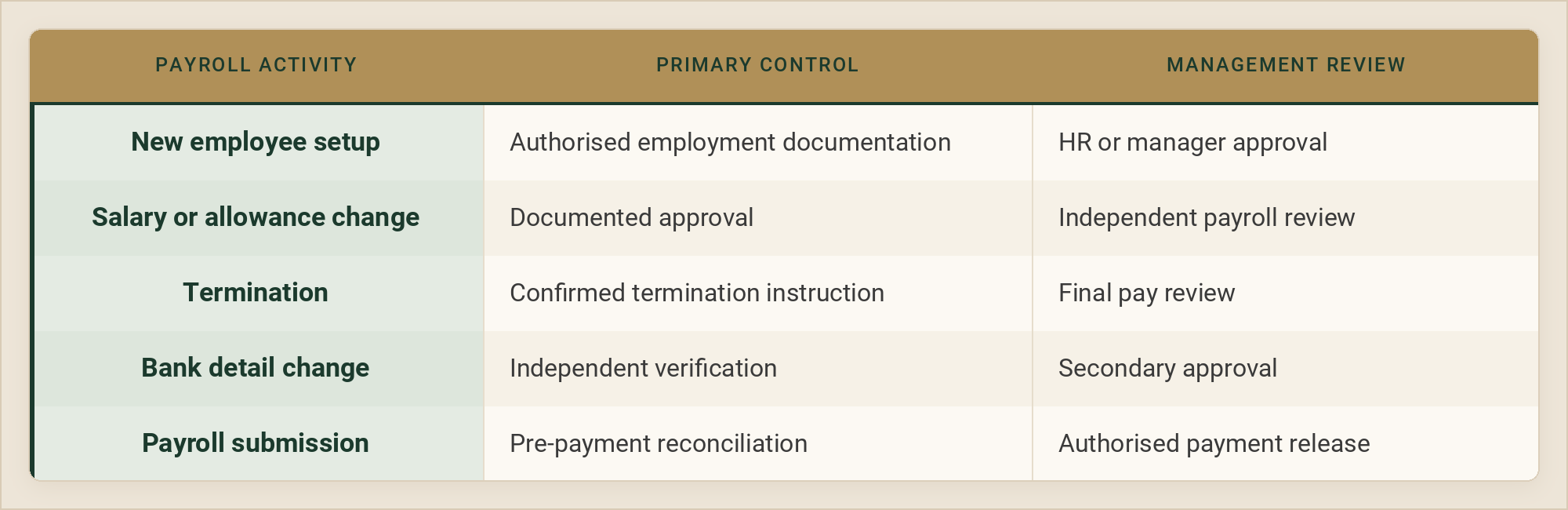
The goal is not to add unnecessary paperwork. It is to make sure important payroll changes receive an appropriate review before they affect employee payments.
This also matters when a business uses employee payroll management services or external payroll processing services. Outsourcing payroll administration does not remove the need for appropriate employer oversight.
Reconcile Payroll Before Payment
A payroll register can look correct and still contain errors.
You may only notice the problem when you compare it with:
- Approved employee changes
- Previous payroll periods
- Headcount records
- The general ledger
- Payroll liabilities
Suppose a monthly payroll increases from $400,000 to $470,000. That increase may be completely legitimate. Perhaps the company hired new employees. Perhaps bonuses were paid. But without a reconciliation, management cannot easily tell whether the increase makes sense.
A useful reconciliation asks:
What changed, and does the change have a valid explanation?
The IRS states that employers remain responsible for employment-tax liabilities even when they outsource payroll duties to a third-party provider. If the provider fails to make required federal tax payments, the employer can still face penalties and interest.
So, even when payroll is outsourced, independent review still matters.
Separate Payroll Preparation and Payment
Here is another control that can easily be missed. A payroll file may reconcile perfectly.
But if the person who prepares payroll can also release the payment, there is still a governance risk. Payment authorisation should sit with an appropriately authorised person who can review the final payroll independently.
Before payment is released, the reviewer should check that:
- Total payroll agrees with the approved payroll register.
- Significant movements have clear explanations.
- New starters and leavers have appropriate approvals.
- Bank account changes were independently verified.
- Payroll taxes and other liabilities reconcile with supporting records.
- Payment release has separate authorisation.
This creates a clear separation between preparing payroll and authorising payment. The same principle applies when a business uses Employer of Record (EOR) payroll arrangements. Clear ownership prevents responsibility from becoming blurred between the business and the provider.
Restructure Payroll Liabilities
Payroll costs are not limited to employees' net pay.
Employer contributions, employee deductions, benefits, and other payroll liabilities are essential components of payroll management. These balances can accumulate over several pay cycles, and if not reconciled, even a small discrepancy can escalate into a significant reporting issue later on.
A thorough payroll reconciliation should involve comparing the payroll register with the general ledger, tax deductions with statutory liabilities, employer contributions with recorded expenses, outstanding liabilities with subsequent payments, employee deductions with authorized arrangements, and payroll reports with statutory information.
These balances can build up across several pay cycles. If they are not reconciled, a small difference can become a bigger reporting issue later.
A strong payroll reconciliation should compare:
- Payroll register with the general ledger
- Tax deductions with statutory liabilities
- Employer contributions with recorded expenses
- Outstanding liabilities with subsequent payments
- Employee deductions with authorised arrangements
- Payroll reports with statutory information
In the UK, HMRC requires employers to retain records covering employee pay, deductions, reports submitted to HMRC, payments made to HMRC, leave and sickness information, tax code notices, and taxable benefits. These records generally need to be retained for three years from the end of the tax year.
Now consider a simple example. Your payroll records show $25,000 in tax liabilities. The financial records show $22,000. There is a $3,000 difference. It may be a timing issue. It may be a posting error. It may have another explanation. The reconciliation tells you that the difference needs attention.
Review Year-End Payroll Reports
Year-end payroll should not become a last-minute exercise.
It is an opportunity to check whether the year's payroll records agree with:
- Financial records
- Statutory submissions
- Employee records
- Payments made
- Outstanding liabilities
The UK PAYE framework uses real-time information, including full payment submissions, to receive employee payment and deduction information each time employees are paid. HMRC also maintains year-end records used to reconcile annual pay and tax information.
But there is a catch.
Year-end should not be the first time management looks for payroll discrepancies. Regular reviews make the final reporting process much easier. Think of year-end as the final checkpoint, not the first review.
Connect Payroll With Compliance
Payroll administration and compliance should not operate in separate boxes.
- Employee changes affect calculations.
- Calculations affect payments.
- Payments affect financial records.
Statutory requirements affect how all of these activities are managed.
This necessitates that responsibility is clearly defined across various areas, including employee records, payroll calculations, statutory reporting, approvals, record retention, and payment obligations.
Australia provides a useful example.
The Fair Work Ombudsman requires employers to maintain accurate and complete employee records and retain them for 7 years. Pay slips must also contain prescribed information, including payment dates, gross and net amounts, deductions, allowances, and superannuation information.
So, good payroll administration and compliance keeps these responsibilities connected instead of treating compliance as a separate paperwork exercise.
Examine Payroll Controls as Business Grows
A payroll process that works for 30 employees may not work as well for 300. Growth changes the control environment.
You may have:
- More employees
- More managers approving changes
- Higher payroll values
- More complex compensation
- Different employee categories
- Outsourced payroll providers
- More people with system access
Now is the time for businesses to evaluate their payroll controls. Ask yourself if these controls still align with your current operations. A thorough review can help ensure that your payroll processes remain effective and relevant to your growing needs.
Consider whether payroll responsibilities are clearly defined and separated among team members. Check if approval limits are suitable for your current business size. It's essential to ensure that access to payroll systems matches each employee's job responsibilities to maintain security and efficiency.
Finally, make sure reconciliations occur regularly and that payroll liabilities are closely monitored. Document provider responsibilities clearly and ensure management receives adequate information for payroll reviews. Adjusting controls based on evolving risks is crucial for maintaining strong payroll governance.
Final Thoughts
Strong payroll governance does not mean adding layers of approval to every task. It means putting the right controls around the points where errors, unauthorised changes, or compliance failures could create financial exposure.
If your payroll process has become more complex as your business has grown, let us review its controls, which can help identify gaps before they become larger financial or compliance problems.
Frequently Asked Questions
Our payroll costs keep changing unexpectedly. How can we tell whether this is a control problem?
Compare payroll movements with authorised employee changes, compensation adjustments, headcount, deductions, and previous-period results. This can help separate legitimate cost changes from recurring processing issues, unauthorised changes, or weaknesses in payroll review procedures.
We keep finding payroll discrepancies during reconciliation. What should we investigate?
Trace differences from the payroll register through the general ledger, liabilities, employee records, and payment records. Look for recurring patterns instead of correcting each variance separately. Repeated issues may point to weaknesses in data, calculations, approvals, or reconciliation ownership.
Our payroll provider handles everything. How can management maintain oversight?
Define responsibilities between the business and provider, then establish the reports, reconciliations, approvals, and exception reviews management should receive. This provides visibility over important payroll activities without requiring internal teams to duplicate the provider's processing work.
Our year-end payroll reports are difficult to reconcile. What should we review during the year?
Review payroll records, liabilities, payments, employee changes, and financial postings throughout the year. Regular year-end payroll reports and reconciliations can help identify differences earlier and reduce the number of unresolved items carried into year-end reporting.
How can repeated payroll adjustments indicate a deeper control problem?
Review the nature, frequency, value, and source of the adjustments. Repeated manual changes may indicate weaknesses in employee data, approval procedures, payroll calculations, or process design. The pattern matters because recurring corrections may signal an underlying control issue.
Does outsourcing payroll remove the employer's responsibility for payroll compliance?
No. Outsourcing payroll processing can transfer specific administrative activities, but the employer may retain responsibility for certain payroll and employment-tax obligations. Clear responsibilities, reconciliations, approvals, and reporting should therefore remain part of the control framework.
Author
Written by Javeria Ahmed and reviewed by Hamdan Ahmed, ACCA.
References
Fair Work Ombudsman. (2026). Pay slips and record-keeping. Australian Government. Fair Work Ombudsman: Pay slips and record-keeping
PAYE and payroll for employers: Keeping records. (2026). GOV.UK: Keeping payroll records
Internal Revenue Service. (2026). Outsourcing payroll duties. U.S. Department of the Treasury. IRS: Outsourcing payroll duties
U.S. Department of Labor. (2026). Recordkeeping and reporting. U.S. Department of Labor. U.S. Department of Labor: Recordkeeping and reporting
Glossary